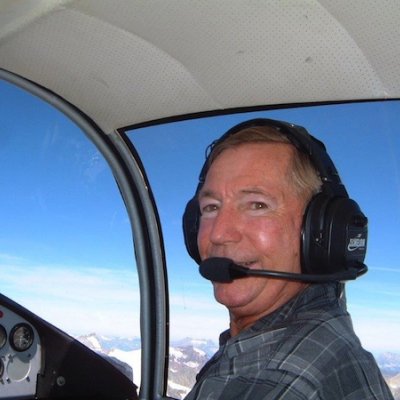
Robert Merloz
Portrait by Jean-Claude Roumilhac

Robert Merloz. For many pilots, this name evokes the creation of Air Alpes, the first landing in January 1962 on what would become the Méribel Altiport, the start of mountain training at the SFA, and his roles as captain and head of the A320 and B747-400 divisions at Air France. But for all of us, mountain pilots, Air France pilots, and others, this name evokes much more than that. It evokes a formidable pilot whose professional and personal qualities were unanimously appreciated, in short, an aviator of great humility whom we all respected and whose career we all envied.
I met Robert in 1990. I was a young captain and flight instructor on the A320. He was my division manager. But the professional relationships that can be formed within a large company are most often limited to a few hierarchical contacts... In February 1991, while training young ab-initio pilots at the Nîmes airfield, I experienced an unpleasant technical incident that marked the early years of the Airbus A320. It was then that I came to appreciate Robert's qualities as a division manager. He gave me a helping hand that I have never forgotten. I was also able to discern the contours of a well-formed character: that of Merloz, a native of Savoy.
Of course, before this incident, I knew the name Robert Merloz, who was behind the introduction of the A320 at Air France and who, among other things, had flown over the Champs Elysées with the President of the Republic, a flight during which he had experienced some difficulties with the aircraft's systems.
My curiosity and my interest in human relations made me want to go further, to learn a little more, beyond the technical aspects. It was also at this time that my steps (or rather my skis) led me to Méribel. There I discovered a mountain flying club. When I joined this flying club in 1990, a stronghold of the Red Musketeers, the first person I met was Nano Chappel. Nano, with whom I had shared many flights as a co-pilot on a B747 and who would give me my first taste of mountain flying. Nano had flown for many years with Robert Merloz as his co-pilot. Nano often talked to me about Méribel, the mountains, and Robert Merloz... I listened.
Intrigued and captivated, I discovered the magic of flying in this place dedicated to mountain flying. Rigorous, refined, aesthetic. At every hour of the day, at every moment, summer and winter alike, the light changes and sets the mountains aglow. Flying within the Alpine massif, in this incomparable setting, landing on glaciers, is like composing a new poem at every moment for aviators who love the feeling of freedom, of precise and simply beautiful flight.
Let's go back a few years. It's January 21, 1962, and Michel Ziegler and Robert Merloz are preparing like navigators to take off from Chambéry for “new lands.” They have just launched the new airline Air Alpes, which they founded, and want to develop mountain flights in particular for the benefit of the growing ski resorts. A few minutes' flight away, Méribel and Courchevel await them. A clearing near the Fontany forest in Méribel has been prepared by ski instructors, with groomed snow and skis at the ready. Michel piloted the Pilatus Turbo Porter and Robert the Piper PA 18. Robert was 25 years old at the time and had 300 hours of flight time under his belt. The prepared landing strip was barely 200 meters long and a few meters wide. There was no established method for flying in the mountains at the time.
The decision was made to land the Piper first, as it presented less risk. The short landing was very precise, and Robert, who had just landed a plane in Méribel for the first time, even had to apply full engine power to reach the top of the platform. Michel Ziegler joined him a few moments later with the Pilatus. That same day, they went on to discover Courchevel.
Today, the Méribel runway (LFKX) is still in the same place Robert chose for it, 400 meters long and 15 meters wide, paved in summer.
A few days later, Desoche, Becker, André Tournier, Joseph Szydlowski, president of Turboméca, Michel Ziegler, and Robert Merloz arrived in a Pilatus aircraft powered by an Astazou turbine. It was on this day that Joseph Szydlowski, affectionately known as Jojo la Turbine, first used the term “altiport” to describe this runway and its surroundings.
Robert Merloz was entrusted with the management of this Méribel “altiport.” He was also an instructor at the brand-new flying club. The rigorous method of mountain flying began to be taught. At the same time, it was necessary to create a nomenclature for altiports, altisurfaces, and glaciers, and to train the first mountain pilots. With experience, the method was refined. This technique, which is still taught today, is based on flying based on the precise choice of the end point of the chosen trajectory, strict adherence to the approach slope, and a speed decided in advance and maintained with precision. All the aerological phenomena known in the plains must be reconsidered in the mountains. Winds, slope breezes, gusts, and other updrafts are sometimes helpful, but often become formidable adversaries. Let's not forget that one of the first schools based in Chamonix in the Mont Blanc region was run from 1925 by Joseph Thoret, known as “Thoret Mont Blanc,” and was already called “l'école des Remous” (the school of eddies), a name that could still be perfectly appropriate today!
Since then, Robert Merloz has remained the same. Quite simply. He is still driven by a deep desire to pass on his knowledge in all forms. His publications and articles in the press led to the publication in 1972 of a book entitled “Le pilotage en Montagne” (Mountain Flying), co-written with Nano Chappel. His extremely detailed briefings, with their surgical precision and mountain-like rigor, and his tenacity have earned him the admiration of many pilots, including some chief pilots who have had the privilege of benefiting from his advice.
Robert speaks so accurately about the mountains, his passion. Everyone listens. His presentations on the mountains and on the technique of flying at altitude are savored “religiously.” So much so that this knowledge lives on: his mountain flying course is still available today on the Internet via the Méribel Flying Club website.
Robert is the pilot we all want to be. He gives real meaning to this life. He is a rigorous, precise, exemplary pilot and also a man of great, unsuspected moral strength. As a true mountaineer, he is of course capable of overcoming difficult moments. But he also knows how to help us overcome them. For years, he has been inspiring younger people in their desire to devote their lives to aviation.
This eternal lover of the air (he was a glider pilot, private pilot, professional pilot, founder of an airline, instructor at the SFA national center in Challes les Eaux, airline pilot instructor, captain of the most beautiful planes of his time, and division manager with very high responsibilities) returned to his passion for mountain flying. The perfect circle.
No one can forget the Savoyard side of his character, and one cannot help but think of the words of Roger Frison Roche:
“Leaving, returning, opening the doors of the valley, going far away to see other things and other people, and then returning to the foot of the mountains to contemplate them again, with a gaze changed by all your experiences: that is the lesson of a lifetime.”
I believe this sentence perfectly describes Robert's life, that of a man who always wanted to discover what lay beyond the mountains here and elsewhere.
Tribute by Éric Merloz, his son
Robert Merloz was born on May 29, 1936, in Paris's 10th arrondissement.
Robert MERLOZ's parents, Paul and Blanche, were originally from Côte d'Aime (Savoie). He spent his youth in Levallois-Perret, where his father ran a moving company called “Aux Porteurs Réunis.” Robert MERLOZ obtained his private pilot's license at the Air France Flying Club in Toussus-le-Noble on May 9, 1955, and participated in three Young Pilots air shows on Stampe in 1954, 1955, and 1956.
It was at the Paris Chamber of Commerce School on Rue Armand Moisant in Paris's 15th arrondissement that he met Michel Ziegler. For 27 months, from 1956 to 1958, he fought in the Algerian War. In 1959/1960, he was employed by the aircraft manufacturer Breguet in Aire-sur-l'Adour. On March 11, 1959, Robert MERLOZ obtained his professional pilot's license. In October 1959, he made his first landings on glaciers during a week-long training course in Sion in the Swiss Valais, with the “Eagle of Sion,” Hermann Geiger. In June 1961, as a glider test pilot for Breguet, he presented the “Choucas” at the Paris Air Show.
On July 1, 1961, Michel Ziegler and Robert Merloz founded Air Alpes (with a fleet of two aircraft: a Piper PA 18 with 150 hp and a Pilatus with a 530 hp Turboméca Astazou turbine engine). At the end of the summer of 1961, work began on developing the Méribel runway. On February 4, 1962, Robert Merloz made the first landing at the site that would become the Méribel Altiport aboard a Piper PA 18, registered F-BKBF, and at the Courchevel Altiport. On December 15, 1962, with the inauguration of the Méribel Altiport, Air Alpes opened two regular routes from Courchevel and Méribel to Geneva and Lyon-Bron, along with numerous ski drop-offs on the glaciers. In 1963, Air Alpes opened routes to Megève, La Plagne, Tignes, and Val d'Isère. On December 11, 1964, the first landing took place at the Megève Altiport. Robert MERLOZ made his last flight with Air Alpes on April 15, 1964. In 1964, the Méribel Flying Club was created (1 Morane Rallye and 1 Piper PA 18) with Nano Chapel, an Air France pilot, as its president. Robert MERLOZ was a volunteer instructor before becoming a full-time instructor in 1965, then a mountain pilot instructor at the National Aeronautical Training Center in Challes les Eaux.
On May 29, 1967, Robert MERLOZ began a 27-month internship as an airline pilot with Air France. In August 1968, he became a co-pilot on the Caravelle SE 220; in February 1972, a co-pilot on the Boeing 737; in early 1980, captain on the Caravelle SE 210; in early 1983, he became captain and instructor on the Boeing 737; in 1988, he became captain on the Airbus A 320 and Head of the Airbus A 320 Flight Division; at the end of March 1988, he flew the Airbus 320 over the Champs Elysées with French President Jacques Chirac on board. 1991, captain on Boeing 747-400, then Boeing 747-400 Flight Division Manager when the aircraft was introduced into the company's fleet. After a final flight to New York, Robert MERLOZ retired from Air France on May 29, 1996, with 16,821 flight hours.
In 1998, he worked as an instructor at the Méribel Flying Club, and from 1999 to 2003, he was its president. A microlight pilot in 2006 and seaplane pilot, Robert Merloz was a member of the French Association of Mountain Pilots. He took his last flight in Le Broc (Alpes-Maritimes) on October 23, 2009.
Letter from Michel Ziegler
Courchevel, July 21, 2001
To Robert!
It's 7:30 p.m., after a busy day, I'm relaxing with Martine in our chalet at the Altiport in Courchevel.
The sun is about to disappear behind the LOZE, but it will continue to bathe the Altiport in Meribel for a while longer.
This is a time of day that I particularly enjoy. The shadows will now gradually lengthen, enveloping Roc Mugnier, then Aiguille du Fruit, then Aiguille de Mey
La Grande Casse, the Dôme de Bellecôte, the Grand Bec, and the Dôme de Chasseforêt will light up, then fade one after the other, and the sky behind them will turn a deep blue.
I will go to the other side of the house to see the last glow on Mont Blanc. Then night will fall, inviting new daydreams.
Tonight you will be, a little more than usual, at the forefront of my thoughts, as I had the joy of hearing you.
Robert, of course you remember that the very first ray of sunlight, very early in the morning, touches the dome of the Gouter, which allowed us, emerging from the darkness of the Fayet, to settle there at the break of dawn.
It was an extraordinary blessing. Then, with all our skill, we would dive back into the darkness to pick up other companions and bounce back towards the light and glory of those peaks that we have always cherished with all our souls.
Robert, do you remember Chasseforêt, where we could land in high winds because, uniquely, we could land there in both directions?
Do you remember Cul du Nant with its slope and Ruitor? Do you remember the top of Solaise? We were pretty bold and really skilled at landing and taking off from there.
But weren't our passengers the most daring? In the end, they were right to trust us.
Do you remember André Tournier, Dédé Simond, Dédé Diard, Robert Blanc, and of course Hermann, Fernand, and Henri, all those great and endearing figures we had the good fortune to know?
And then that page turned, and one evening in Satolas, returning from Copenhagen in a Fokker 28, a tester from Air France shook my hand and gave me my final pass for the “Airline Pilot” exam. You had probably passed it some time before... What joy!
Robert, when we used to ride around Paris on the “125 PUCH double carburetor,” when we were just starting out in Toussus, on STAMP or NC 853, did we ever dream of such achievements?
You see, I think about it not with nostalgia, but with gratitude for all the happiness we shared.
A few days ago, you moved me deeply when you said to me on the phone: “Michel, I have suffered greatly, and I have discovered that suffering sublimates our sensitivity and that it is a passageway to a greater Love...”
This is essentially what Jesus said to his apostles on the Mount of Olives on that dramatic night of Holy Thursday, which marks our universe forever.
Each of them saw in this extraordinary Man the Messiah announced by the prophets and awaited by Israel, naturally a triumphant Messiah.
But now he was telling them that he was going to be captured, tortured, ridiculed, and finally suffer the most infamous death on the Cross.
They are devastated:
Judas, the scholar from Judea, goes to betray him as an impostor,
and Peter, a rough fellow full of common sense, a Galilean sinner—I think of him when I see the image of Dédé SIMOND—says to him, “No! Let us flee, let us hide, or call upon your heavenly legions to escape this terrible fate.”
And Jesus said to him, "Get away from me, tempter, my destiny must be fulfilled, for redemption comes through my suffering and resurrection through death.
Come on, Robert, take courage in this difficult trial you are going through, you are going towards Eternity and we will keep you in our hearts.
Michel